
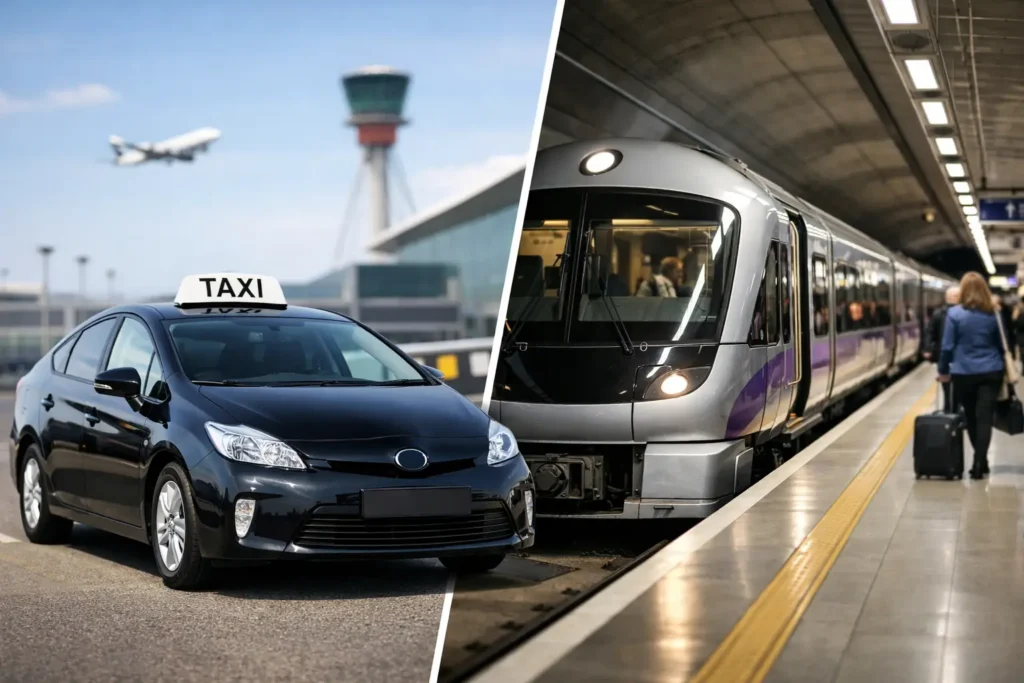
A 6am flight can make the taxi vs train Heathrow decision feel less like a travel question and more like a stress test. If you are leaving from Buckinghamshire or the Chilterns, the best option often comes down to one thing – how much uncertainty you are willing to manage before you even reach the terminal.
For some travellers, the train is quick, predictable and good value. For others, especially families, groups, or anyone travelling from a smaller town, a pre-booked airport taxi is simpler from the start. The right answer depends on your route, your luggage, your timing and whether you want to deal with changes along the way.
On paper, rail can look like the obvious choice. Heathrow has strong train connections into London, and if you are already near a station with a straightforward route, it may work well. But airport journeys are rarely just station to station. They are front door to terminal, often with cases, hand luggage, children, work bags or tired passengers in tow.
That is where the comparison changes. A taxi is not simply transport to Heathrow. It removes several moving parts at once. There is no parking to arrange at the station, no platform changes, no dragging luggage through barriers, and no last leg from the rail station to the right terminal entrance. You are collected from your address and dropped where you need to be.
For travellers in places such as Great Missenden, Holmer Green or Lane End, that difference matters. A train journey may begin with a lift to the station or a local cab anyway, which adds cost, coordination and another point of failure.
The train can be a sensible option if you are travelling alone, light on luggage and during normal daytime hours. If you live close to a station, know the route well and have some flexibility, rail can be efficient.
It can also suit regular business travellers who are comfortable with station changes and do not need door-to-door service. If your meeting is in London before your flight, combining city travel and airport rail may feel natural.
There is also the matter of traffic. Road journeys to Heathrow can vary depending on the time of day, the M4, the M25 and local congestion around the airport. Trains are not immune to delays, but they are not sitting in motorway traffic either. For some passengers, that fixed track schedule feels more reassuring than the road.
Even so, train convenience drops quickly when the journey becomes indirect. If you need one train to London, another connection, and then an airport service, your total journey can become longer and more tiring than expected.
A taxi usually comes into its own when the journey needs to be simple. Early departures, late arrivals, children, elderly relatives, ski bags, pushchairs, or multiple suitcases all shift the balance.
A pre-booked airport taxi is especially useful when your train option starts with a compromise. Perhaps the nearest useful station is not that near. Perhaps the service is limited at the time you need to travel. Perhaps you do not want to ask someone for a lift at 3am. In those cases, the train may still be possible, but it stops being the easy choice.
For airport travel, reliability is about more than being cheap or fast in ideal conditions. It is about how many things must go right. With a taxi, the journey is more controlled. Your driver knows the pickup point, the terminal and the timing. If the service includes flight monitoring for return journeys, that is one less thing to worry about after landing.
This is why many customers looking at Heathrow airport transfer options end up choosing a booked car even if the train first appears cheaper.
The train often wins on headline price for a solo passenger. That part is true. If one person is travelling with a small bag and a straightforward route, rail can cost less than a private taxi.
But that comparison changes once you count the whole journey. You may need a local taxi to the station, train tickets at peak times, and possibly another transfer depending on your route. Add two, three or four passengers and the gap can narrow quickly. For a family or small group, one fixed taxi fare can compare surprisingly well against multiple rail fares.
There is also the question of hidden costs, not just ticket prices. If a delayed train means extra waiting, missed connections or the need for a last-minute cab, the cheapest option can become the most expensive one.
With a pre-booked airport taxi, the value is in certainty as much as price. Fixed fares, a confirmed pickup and a direct route remove the need to keep adjusting the plan.Compare airport transfer and parking costs here
This is where taxi vs train Heathrow becomes much easier to judge. If you have more than one suitcase, awkward luggage, or children to manage, door-to-door travel usually wins.
Train travel with luggage is manageable, but not always pleasant. Lifts can be out of service. Platforms can be crowded. Changing trains with large cases is tiring before a holiday and worse after one. If you arrive back at Heathrow late in the evening, the idea of hauling bags through rail connections may be the last thing you want.
A taxi is also easier when the group has mixed needs. One person may be fit and happy to take the train, while another needs extra time, space or assistance. A private vehicle keeps everyone together and removes that friction.
Airport travel is rarely at the most convenient hour. Flights leave early. Long-haul arrivals land late. Delays happen. Trains may run less frequently in the very early morning or late evening, and engineering works can catch people out at weekends.
That does not mean rail is unreliable by default. It means your margin for error may be smaller than you think. If one missed connection puts your airport timing at risk, that is worth taking seriously.
A pre-booked taxi gives you more control over awkward departure times. It also avoids the common problem of getting to a station on time, then standing around waiting with luggage because the train timetable does not line up neatly with your flight schedule.
If you are comparing options for a return trip, the advantage can be even clearer. After a long flight, most people want the simplest route home, not the cheapest possible sequence of trains.
Families usually place convenience first. Getting everyone into one vehicle, with space for cases and hand luggage, tends to beat managing children on platforms and escalators. If there is a pushchair involved, the answer is often obvious.
Groups should compare total cost, not individual ticket prices. Four train tickets, plus station transfers, can add up quickly. A minibus or larger airport vehicle can be more practical and sometimes better value.
Business travellers can go either way. If the route is direct and the timing is civilised, rail may be perfectly suitable. But if the trip starts in a village, includes presentation kit, or needs a very early pickup, a taxi is often the more dependable choice. It also gives you a quieter, more controlled start to the journey.
If you are weighing up the right vehicle size rather than just the route, it helps to check fleet options for Heathrow transfers before you book.
Choose the train if you are travelling alone, packing light, starting near a useful station and happy to manage a route with little room for disruption. It can be efficient and cost-effective when the journey lines up well.
Choose a taxi if you want door-to-door simplicity, have luggage, are travelling very early or very late, or are starting from an area where rail involves extra steps before the real journey even begins. For many airport passengers, especially outside the main rail hubs, that is the more practical choice.
The best Heathrow journey is not the one that looks cheapest on a quick search. It is the one that gets you to the terminal calmly, on time and without unnecessary hassle. If your trip starts or ends with enough moving parts already, keeping the journey simple is often the smartest decision.